2025–present · UMass Robotics · Board design / Firmware
Mega‑CAN
Gig‑E ↔ CAN
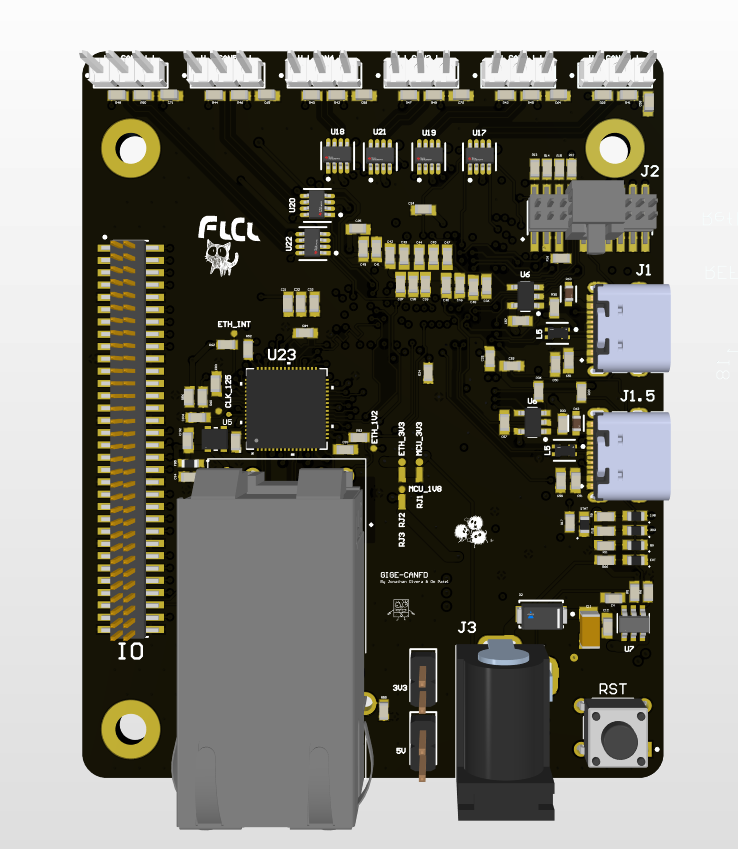
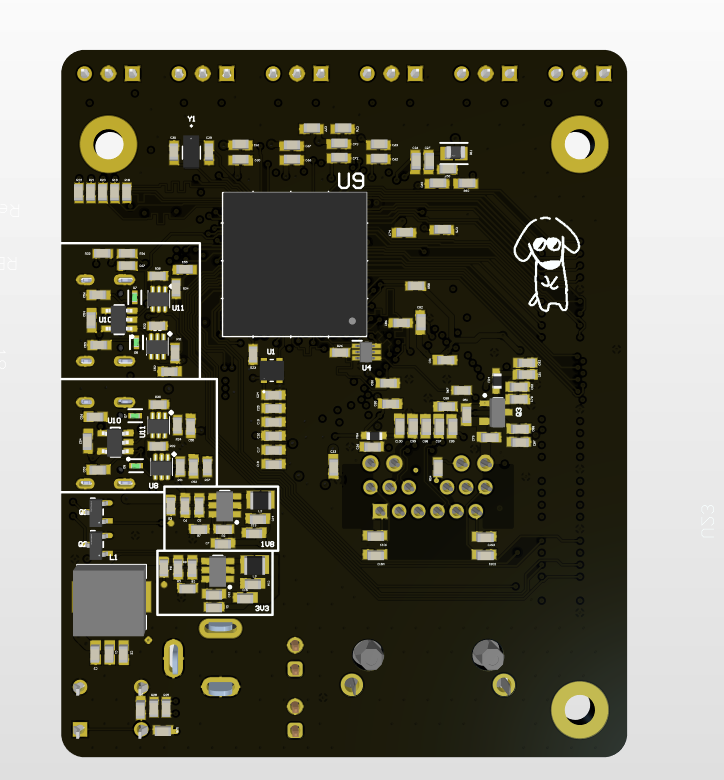
The gateway at the center of the quadruped. Gigabit Ethernet carries a firehose from the Jetson; CAN carries short, hard-deadline frames to the actuators. I co‑designed the 6‑layer board and now own its Zephyr firmware, its integration into the robot, and its move to CAN 2.0B.
Why a bridge at all
The robotics stack wants one cable to the compute box and a deterministic bus out to the actuators. Gigabit Ethernet gives bandwidth and no timing guarantees; CAN gives timing guarantees and almost no bandwidth. The board sits between them and decides what deserves to cross.
Where the documentation runs out
Zephyr has no Ethernet driver for this microcontroller, so I ported Microchip’s GMAC driver to the PIC32CZ and wrote the bring‑up apps: a PHY probe first, then ping and UDP echo. Frame boundaries, priority, what to drop when the firehose outruns the bus — those are decisions, not defaults, and this project is a record of making them.
Inspect
Take it apart yourself
The same export as the study above, but yours to turn. Drag to orbit, pull the slider, snap to a standard view.
Every designator is its own body, so separation lifts each component off the board along its own axis. The board itself is the fixed datum.