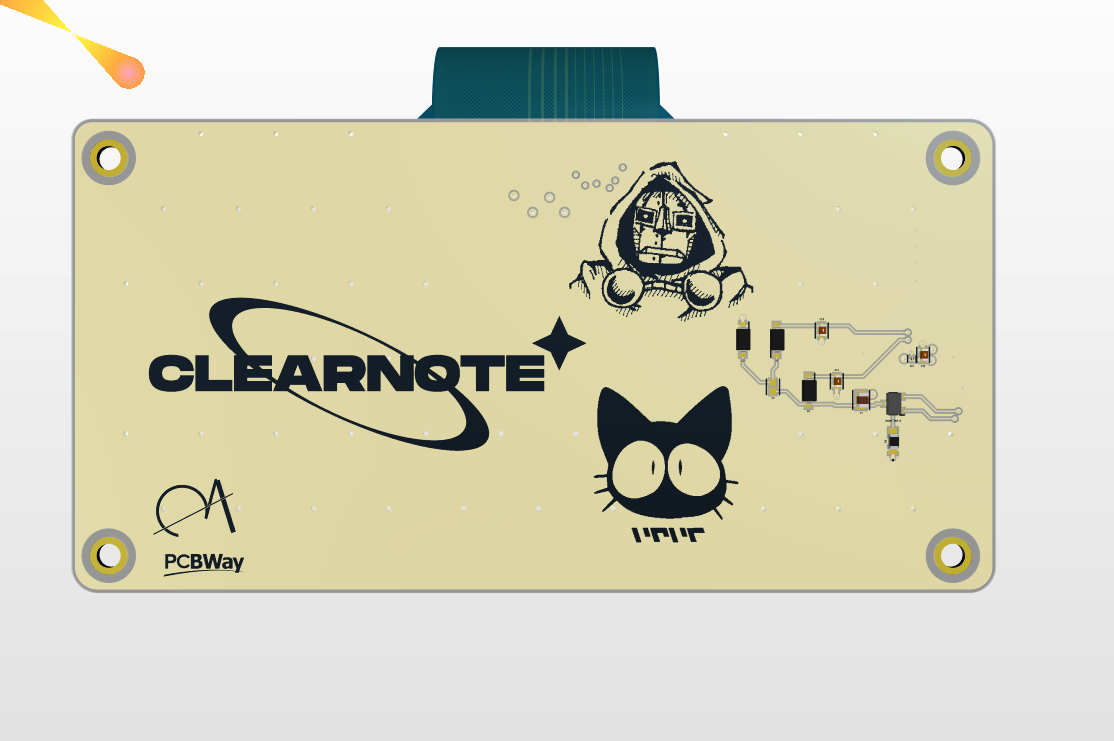
Rev B · 2024–present · Rigid‑flex PCB / Firmware
ClearNote
A digital notepad built around E‑Ink, for studying without a glowing rectangle begging for attention. One device, one job: paper that remembers. It is also my research vehicle — ClearNote investigates how firmware architecture and hardware design choices affect responsiveness and power efficiency in a low-power E‑Ink system.
The problem, stated plainly
E‑Ink is slow and the ESP32‑S3’s shared buses bottleneck easily. The whole project is about refusing to accept that: a 4‑layer rigid‑flex board drawn across seven schematic sheets (USB‑C power path, buck‑boost and LDO rails, an SGTL5000 codec, a 33‑key matrix, microSD, a TMR lid sensor) and a deterministic FreeRTOS firmware strategy, so latency is something I design, not something I get.
Where it stands, honestly
Rev B fixes what my mentor and I caught in review — a missing inductor, thin via stitching, a power-button circuit I was not proud of. A datasheet audit has caught more than twenty defects before fabrication, including a buck‑boost feedback divider that would have overvolted the 3.3 V rail. It orders after this semester’s exams; bring-up follows: power-on, E‑Ink boot, SD card, and the headphone-jack logic for audio studying.